


Paul McDonald in London Grip
Paul McDonald enjoys Peter Finch’s lively and insightful account of more than half a century experiencing the vagaries of life as a writer and literary administrator
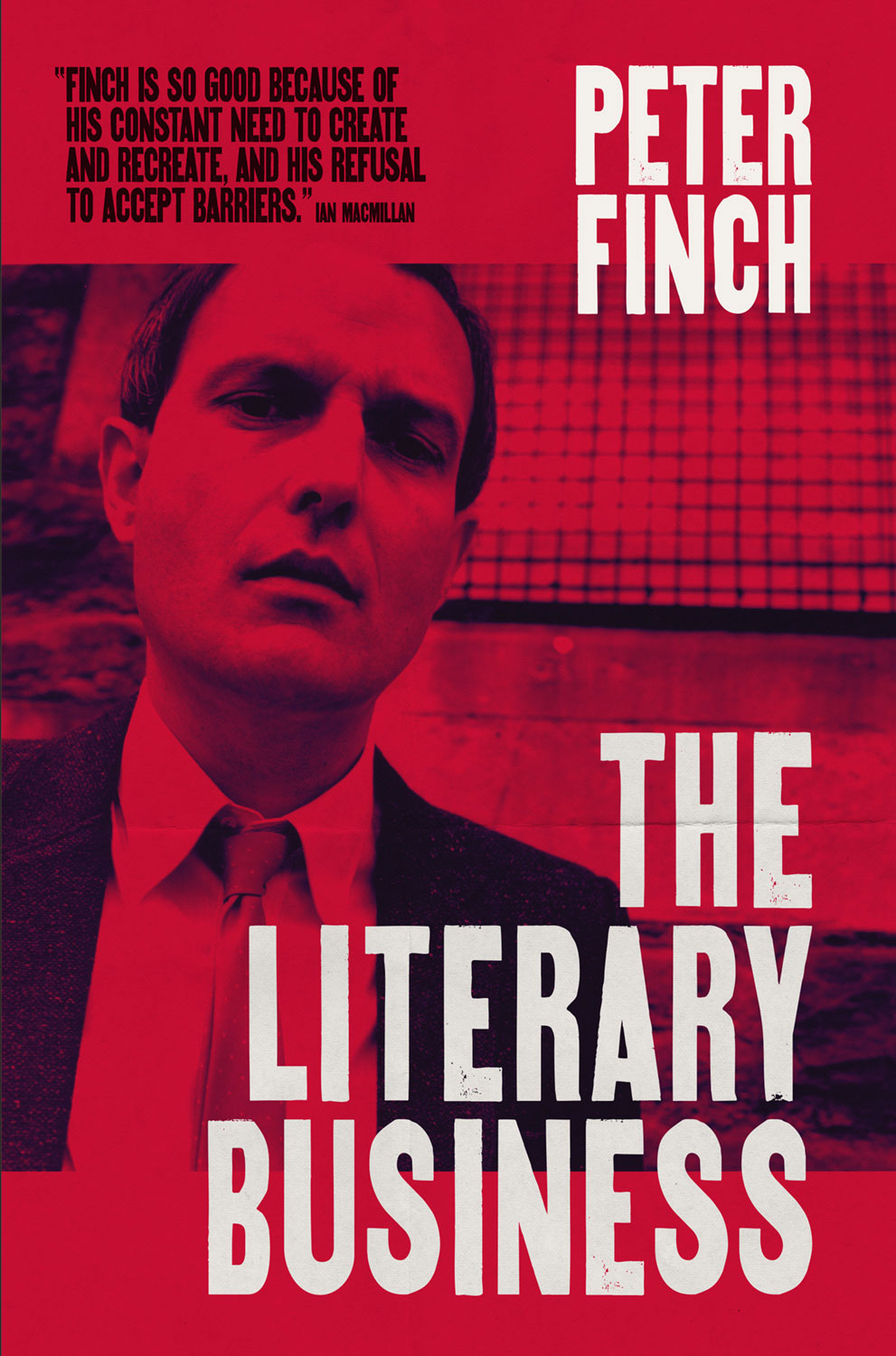
By Finch’s own admission, the photograph on the front cover of The Literary Business casts the young poet as a 1960s gangster, while the snap on the back, taken half-a-century later with noir lighting, black leather jacket, and shaven head, presents him as the 2020s equivalent. In both he has the look of someone who wins more fights than he loses. For poetry lovers this is a good thing, because he’s fighting on our behalf.
Don’t let his scowl fool you: Finch is full of fun and optimism in this memoir, and, perhaps surprisingly for someone who’s often been at odds with bureaucratic institutions, he has few enemies. He seems able to roll with punches, which as an experimental poet is a useful trait; he’s certainly had his share of flummoxed critics, beginning with his first foray into creative life – smitten by the poetic spirit he found in American blues, he penned this lyric:
O I got them blues in Roath Park this mornin’
The sky is full of ducks
My mama got them great big chicken legs
I’m completely out of luck.When Finch asked the lead singer of Amen Corner what he could do with the lyric he replied: ‘Not much’. Undeterred, Finch fought on, driven by a desire to ‘write things, to turn everything … into poetry and to send it out to the waiting world … via the little mags’. When the ‘little mags’ were slow to respond he began his own, the groundbreaking Second Aeon, and we get a fascinating insight into its genesis and evolution over 21 issues from 1966 to 1974. It is this journal, together with the accompanying book series and reading events, that raised Finch’s profile in Wales, and subsequently beyond.
In a succession of succinct, episodic chapters Finch provides an entertaining account of his rise to prominence, conveying a strong sense of the cultural moment, from the Beatnik and Pop Art inspired ‘60s, to the Poetry Wars of the ‘70s. I particularly enjoyed his warm, colourful portraits of key figures from the experimental poetry scene, including the ‘cosmic traveller’, George Dowden, in his ‘bright orange Hindu robes’; the concrete/sound poet Bob Cobbing ‘sockless in sandals’, ‘rolling through an hour-long reading … without a single piece of paper anywhere’; and John Tripp, ‘the Welsh version of Charles Bukowski’, a ‘rager who let it flow’…
Finch’s life contains more than just poetry, but his love of literature is his principal driver, underpinning everything, from running the Welsh Arts Council’s Oriel bookshop for 25 years, to his role as head of the Academi (the Welsh National Literature Promotion Agency and Society of Writers). We hear of his frustration when control of the former was passed on to the private sector, precipitating its inevitable decline; we hear of the ‘thick skin’ required to administer ‘literary Wales’, where rivalries and ‘conspiracy theories’ abound. Fortunately Finch has a very thick skin indeed, and this, together with the energy that fuels his poetry, makes him a formidable force. Finch isn’t just a poet, then, he’s someone who strives to prove that the phrase ‘literary business’ isn’t a contradiction in terms – he has chapters on how to publish poetry, market it, organise readings, and, not least, balance the books. His mission has been to facilitate other people’s creative work as well as his own, operating at every level, from cultural governance to writing advice. While this is by no means a ‘how to’ book, he has illuminating chapters on various aspects of creating poetry and performing it, offering his own experience and practice as examples. He doesn’t always get it right, acknowledged in chapters like ‘How Not to Do It,’ which illustrates the pitfalls of prefacing performances with a liquid lunch, but we can learn from his mistakes as well as his successes.
Among my favourite chapters are those offering insights into his own aesthetic, which, like his life in general, is multifaceted. The five ‘How Poems Arrive’ chapters discuss his Burroughs and Gysin inspired cut-ups, his sound poems, his computer-assisted R.S. Thomas manipulations, his place poems, and his confessional poetry. In the latter he reflects on Wordsworth’s definition of poetry as ‘emotion recollected in tranquillity’, and his own view that poetry ‘enables you to fix emotion, somehow’. He offers two poignant examples, both responding to events that happened on the same day: as he watched his wife’s possessions being removed from the family home following their break-up, the phone rings with news that his father has suffered a heart attack. His poem, “Fists”, explores the first event and the trauma of separation, how at one point he ‘punched a hole in the wardrobe door’ in frustration, concluding:
I pass you your junk mail you put it
in your bin.I walk behind people in crowds, imitating
their steps, not being me, seeing what it
is to be them.It works occasionally, now and then. You
don’t recognise me by the veg
in the supermarket.My fist in the frozen peas. You with him.
The loss of his partner precipitates a loss of identity, not just erasure from his old lover’s life, but life in general; his rejection and abjection are underscored succinctly in the final, two sentence stanza, ‘My fist in the frozen peas. You with him’. The poem about his father, “Heart”, deals with loss of a different kind, equally painful; again his effective use of specific details offers moving emotional depth, as in the penultimate stanza,
Sitting in the carpark in the rain his
hat in a Tesco bag trembling heart moving
away from me faster like an accelerating train.In both poems we feel close to Finch’s pain, even though they were ‘created five years beyond the events themselves’ and neither ‘describe the actual day, with its boxes and phone call and the darkness slowly increasing to fill the hall’ – they are less attempts to fix a moment than, as Finch says, to ‘fix emotion’, which in both cases conveys his helplessness and frustration. Knowing the context deepens our engagement with them, I think, offering an illuminating glimpse of the poet at his most vulnerable – an inspiring example of someone willing to make emotions public. We’re told that he wrote the poems partly because he ‘wanted others to get access to these emotions … You should not write only for yourself’. His willingness to discuss their genesis takes this impulse to share a stage further, offering examples for our benefit – in a sense, the sentiments that inform this chapter reflect the spirit of the entire book: Finch’s art comes from a personal need to create, but his mission extends beyond the self to those of us who may be inclined to follow his lead and make poetry our business.
Original review appeared in London Grip early 2026
The Literary Business is published by Parthian Books and can be purchased here and at all good bookshops.

If you like what
you read then
why not buy a
Peter Finch
book. Full
bibliography
and ordering
details here
